

Faster feedback, better results: how marking becomes attainment

Every AI marking company will tell you it saves teachers time. We do too, and it's true. But saving time was only one part of the wider mission.
The point is students. If a piece of software marks an essay in minutes rather than weeks, that's an operational win. Whether it becomes an educational win depends on what happens next: what the student does with the feedback, and what the teacher does with the hours they get back.
That's why we've written down our theory of change. It's the chain of cause and effect we believe runs from "Top Marks AI marks this script" to "this student gets a better grade". Writing it down forces us to be honest about which links we control, which we only influence, and which we haven't yet proven. I want to share where we've got to.
From a marked script to a better grade
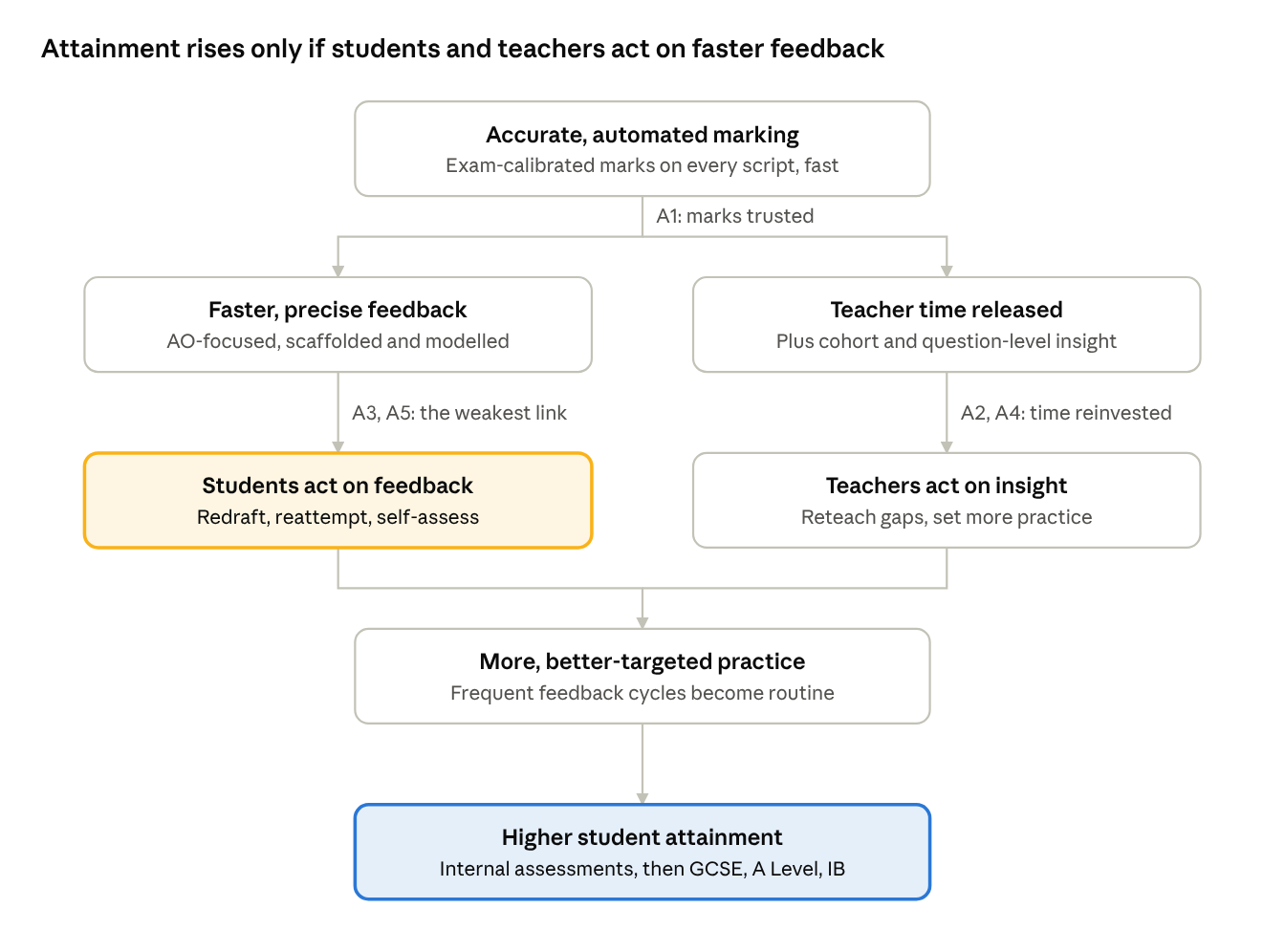
Our central premise is simple: more accurate, automated marking means faster, better feedback for students, and that improves their attainment. In practice, it travels by two routes.
The student route. Top Marks AI marks handwritten or typed work against exam-board standards and returns feedback tied to the assessment objectives. We design that feedback to be scaffolded, modelled and precise. It shows a student where they lost marks, what a stronger answer looks like, and what to do next. Because it arrives in days rather than weeks, the student still remembers their thinking and can apply it to the next task.
The teacher route. The hours a teacher no longer spends marking are freed up so that educators can bring their professional expertise to bear where it matters most. Alongside the automated marking comes whole-cohort and question-level analysis showing which ideas the class has missed. A teacher can reteach the gap on Monday instead of discovering it at the mock. And because marking a set of essays no longer costs a weekend, it becomes realistic to set extended writing more often.
Both routes meet in the same place: students practising the things that matter more often, with better guidance each time. That, we believe, is what moves attainment.
The link we worry about most
When we mapped the chain, one step stood out as the weakest: students actually acting on their feedback.
Any teacher knows the scene. Work comes back, the student looks at the number at the top, and the comments go unread. Fast feedback that nobody uses is just fast paperwork. The research backs this up. Feedback is one of the most powerful levers in education, but not all feedback helps, and feedback that focuses on the grade rather than the task can even hold students back.
So we don't treat this link as a given. Our feedback models what a better answer looks like rather than just saying "add more detail". It's built around the assessment objectives, not the mark. And we're working with schools on routines that give students dedicated time to redraft or reattempt, because that time is where feedback turns into learning.
The same honesty applies to the teacher route. Time saved only helps students if it's reinvested in teaching. We can't control that, but we can make it easier: by surfacing the gaps worth reteaching, and by making frequent practice affordable.
And underneath everything sits accuracy. If teachers don't trust the marks, they re-mark everything and nothing changes. That's why accuracy against exam-board standards is the foundation of our product, and why we keep teachers in control of what goes back to students.
How we'll know if we're right
A theory of change is only useful if you test it. So for every link in the chain, we've named what we'll measure:
- Accuracy: how closely our marks agree with expert markers, by subject and across the full grade range, including the strongest and weakest scripts.
- Speed: how long it takes from submission to feedback in a student's hands.
- Teacher time: how many hours are saved, and, just as important, how they're used.
- Practice: whether schools set more extended writing once marking it is no longer a burden.
- Student action: how many students redraft or reattempt after feedback.
- Attainment: whether students in classes using Top Marks AI improve faster than comparable classes.
I'll be candid. Across our sector, most of the evidence published so far stops at time saved. That matters, especially given what marking does to teacher workload and wellbeing. But it isn't the whole story, and it isn't the story we want to tell. Our plan moves from case studies with partner schools, to matched comparisons, and ultimately to an independent evaluation of attainment. Some of what we find may challenge our assumptions. That's the point.
Test it with us
Our theory of change is a working document, not a finished one. We wrote it to be argued with.
If you're a school or trust leader who shares our belief that feedback should change what students do, not just what they score, I'd love to hear from you. We're looking for partner schools to help us test each link in the chain, and teachers to tell us where our thinking is wrong.
Get in touch at hello@topmarks.ai. Let's find out together whether faster, better feedback really does lead to better results, and what it takes to make sure it does.
We use cookies for analytics and marketing to improve your experience — these are only set if you accept. Decline and we'll only use cookies that are strictly necessary. (Live chat is always available either way.) Learn more in our Cookie Policy.